

Where did water on the earth come from? Where was the organic matter that constitutes life on our planet produced?
C-type asteroid Ryugu in the nearest asteroid belt to the earth is believed to still retain water and organic matter formed about 4.6 billion years ago, around the time when the solar system was born from a spinning dust cloud.
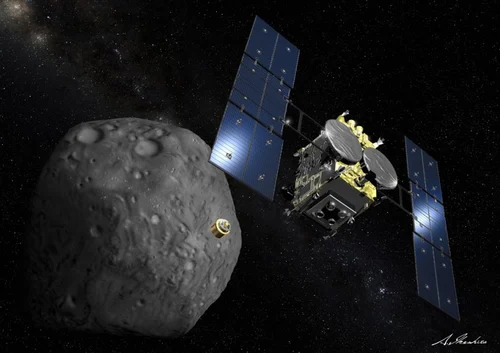
With the aim of gathering samples, “Hayabusa 2” was launched from Tanegashima Space Center on December 3, 2014, and arrived in synchronized orbit with Ryugu on June 27, 2018. It then collected 5.4 grams of sample material and travelled back to the earth, arriving safely on December 6, 2020. Hayabusa had travelled 6 billion kilometers in total over 2,195 days.
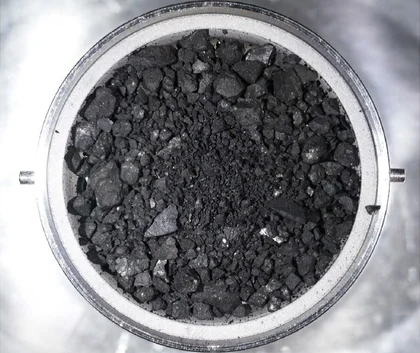
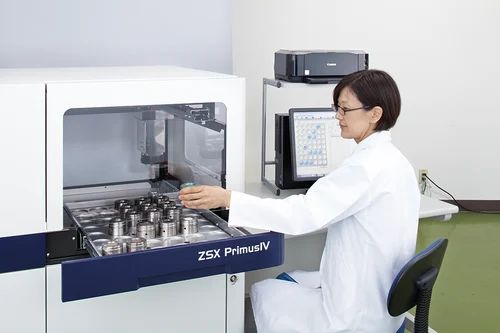
On June 23, 2021, Rigaku, which participated in the initial analysis project, received a 30 mg sample out of 100 mg provided to the chemical analysis team. Using wavelength dispersive X-ray fluorescence spectroscopy (WDXRF), Rigaku performed chemical composition analysis including carbon and oxygen, and specified the content rate of a total of 20 elements of main components and trace elements with a content of tens of ppm or more. This analysis shows that the water content in the Ryugu sample is less than half of that found in CI chondrite meteorites. This indicates that the sample from Ryugu has not been affected by exposure to the Earth’s environment, unlike the CI chondrite meteorites that had hit the earth 80 years before, and retains the elemental composition of the primordial solar system. As a result, the connection between the material chemistry of meteorites that hit the Earth and asteroids still in orbit was proven for the first time.
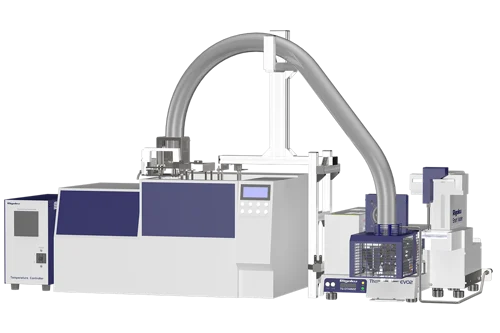
Then in August 2022, Rigaku received another sample of around 1 mg for analysis using thermogravimetry differential thermal analysis and gas chromatography mass spectrometry (TG-DTA+GC-MS). This analysis showed that the amount of water content in Ryugu sample is less than half of that in the CI chondrite meteorites.
This indicates that the sample from Ryugu has not been affected by exposure to the Earth’s environment when compared to CI chondrite meteorites that hit the earth 80 years before, and it retains the elemental composition of the primordial solar system. It therefore has very high value for space science research, including the formative history of the solar system and original source of water.
Rigaku also analyzes the sample which asteroid probe ”OSIRIS-Rex” of NASA collected from asteroid Bennu and plan to compare the result with the one of Ryugu as a part of the NASA analysis team’s research.
Click here for details of ZSX Primus IV
Click here for details of TG-DTA+GC-MS (Japanese)
Click here for press release “Rigaku analyzes samples collected by NASA’s OSIRIS-Rex“